
I walked into the service center yesterday expecting the usual routine. Drop off the truck, wait a bit, pay for an oil change, drive home. Instead, the service advisor sat me down, pulled up the estimate on her screen, and told me that because my Hilux had just crossed 40,000 km, this wasn’t going to be a simple visit.
She explained it plainly. At this mileage, the truck needed real work done, not just a top-up. I looked at the number on the screen and felt that familiar gut punch car owners know too well. I asked her, half hoping, if we could remove some of the items marked optional to bring the cost down. She told me none of it was actually optional. Everything on that list was required for a vehicle at this stage.
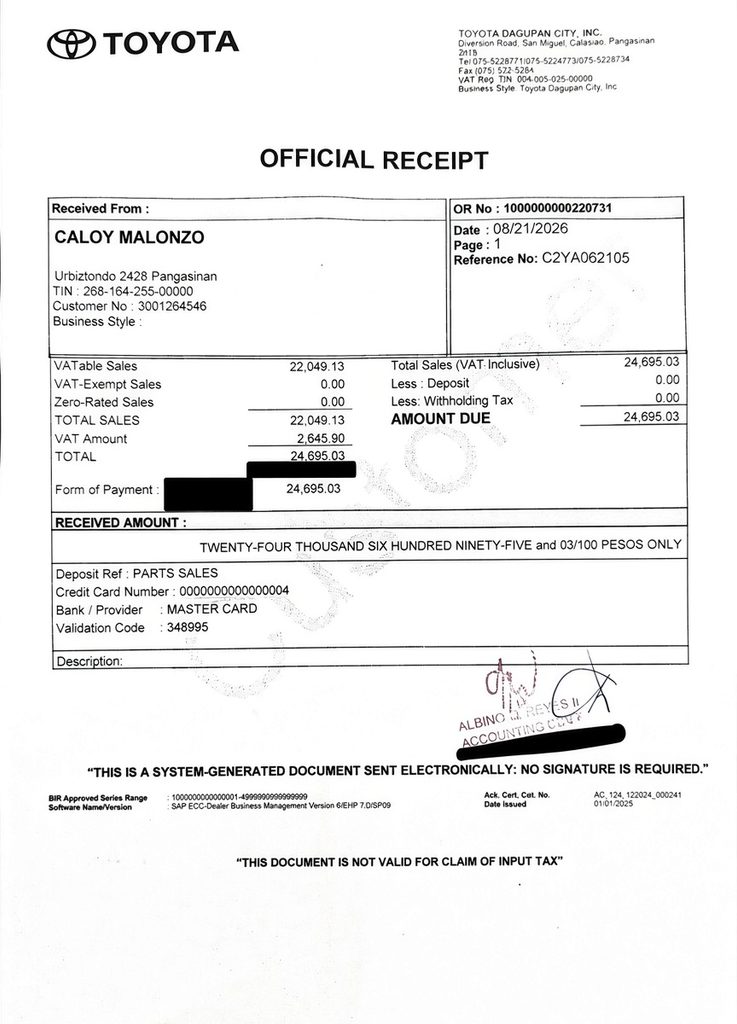
There wasn’t much room to argue. I nodded, signed off, and let them get to work. A few hours later, I walked out with a truck that runs a little smoother and a receipt that reminded me exactly why people say a car is never just the monthly payment.
TL;DR
- Brought my 2024 Toyota Hilux 2.4G into Toyota Dagupan City for its 40,000 km major service at 44,127 km on the odometer
- The service advisor handed me an estimate that made me pause before I even saw the actual invoice
- I asked if any of the items could be trimmed down. She said everything on the list was mandatory for this mileage
- Final total came out to ₱24,695.03, with oil and lubricants alone eating up more than half of that
- The breakdown covers engine oil, differential gear oil, brake fluid, filters, and a long list of inspections across the drivetrain, suspension, and brakes
- If you’re eyeing a pickup, this is the number nobody tells you about when you’re signing the loan papers
What Actually Went Into a 40,000 KM Service
Seeing “40,000 km checkup” on paper doesn’t really tell you much until you see the itemized list. My Hilux runs on diesel, so a chunk of the work centered on things specific to that engine type, on top of the usual mileage-based replacements.
On the fluid and parts side, they replaced the engine oil and oil filter, flushed and replaced the differential gear oil, and swapped out the brake fluid. They also ran a diesel engine flush and used an injector cleaner, both aimed at keeping a diesel engine running clean at this stage of its life. An automatic transmission fluid product was applied as well, along with a fresh air filter element.
Then there’s the long list of inspections that don’t necessarily involve replacing anything, but still take time and labor. The technician checked the cooling and heating system, exhaust pipes and mountings, battery condition, fuel tank cap and lines, brake pedal and parking brake, brake lining and drums, brake line pipes and hoses, power steering fluid, steering wheel and gear box, propeller shaft and its bolts, ball joints and dust covers, front and rear suspension, and all the bolts and nuts holding the chassis and body together. Tires and tire pressure got checked too, alongside a wheel balancing and rotation.
Reading through the full list after the fact, I understood a bit better why the advisor was firm about none of it being skippable. A lot of these aren’t glamorous repairs. They’re the kind of thing you don’t notice until they fail on you somewhere far from home.
Where the ₱24,695 Actually Went
Here’s the part that surprised me most. When I finally looked at the cost breakdown, the biggest chunk wasn’t labor. It was oil and lubricants.
| Cost Category | Amount |
|---|---|
| Total Labor | ₱3,423.21 |
| Total Parts | ₱1,611.69 |
| Total Sublet | ₱170.00 |
| Total Oil/Lubricant | ₱13,186.68 |
| Total Misc/Material | ₱3,657.55 |
| Subtotal | ₱22,049.13 |
| VAT | ₱2,645.90 |
| Total Price | ₱24,695.03 |
Oil and lubricant alone made up more than half the entire bill. That includes the synthetic engine oil, the differential gear oil, the automatic transmission fluid product, the diesel engine flush, and the injector cleaner. Labor, which I assumed would dominate the invoice, ended up being a smaller slice than I expected.
The misc and material line covered things like the air filter element, brake cleaner, brake paste, silicone spray, and a cabin air freshening product. Small items individually, but they add up fast once you’re paying for a dozen of them in one sitting.
The Moment I Asked to Trim It Down
I’ll be honest, my first instinct when I saw the estimate was to look for what could wait. That’s a normal reaction when a number that big shows up out of nowhere on an otherwise ordinary weekday.
So I asked the advisor directly if there were items we could remove or push to a later visit. She was straightforward with her answer. At 40,000 km, everything on that particular list was considered mandatory, not optional add-ons. There wasn’t a version of this service where I could pick and choose.
I won’t pretend that answer made the number easier to swallow. But it did shift how I thought about the whole visit. This wasn’t a case of the shop padding the bill with upsells. It was the actual scope of work a vehicle needs at this mileage marker, especially one that sees regular use.
What This Milestone Service Actually Buys You
Beyond the receipt, what I walked away with was a truck that had its brake fluid, differential oil, and engine oil all refreshed at once, along with a full check across the suspension, steering, and drivetrain. The battery got checked and came back in good condition. Tire pressure was set to 32 psi across the board, and the wheels got balanced and rotated.
None of this is exciting to talk about at a dinner table. But it’s the kind of maintenance that quietly keeps a vehicle running the way it’s supposed to, especially heading into the next stretch of kilometers before the truck’s next major interval.
Key Takeaways
- A 40,000 km major service on a diesel pickup can run well past ₱20,000 once oil, fluids, and inspections are all factored in
- Oil and lubricant costs, not labor, made up the largest portion of my bill
- At major mileage intervals, dealerships often treat the full checklist as mandatory rather than optional, so don’t expect much room to trim the list down
- The bulk of the work is preventive, covering brakes, suspension, steering, and drivetrain components that are easy to overlook until something fails
- Knowing the actual breakdown of a service invoice helps you understand what you’re paying for instead of just seeing a lump sum
- If you own a pickup or any vehicle nearing a major service interval, it’s worth budgeting for this ahead of time instead of getting caught off guard
Owning a vehicle past the dealership showroom always comes with costs nobody really walks you through beforehand. This service was a reminder that the real expense of keeping a truck running well shows up quietly, one mileage milestone at a time. If your vehicle is approaching 40,000 km, it might be worth asking your service center for an estimate ahead of your actual appointment, just so the number doesn’t catch you off guard the way it caught me.
