I noticed them on my first solo trip to Bangkok in 2024, before I knew what they were. Small, ornate houses standing outside hotels, offices, shops, homes. Bright colors, pointed roofs, sometimes elevated on a single pillar, sometimes on several. Someone was clearly tending to them. Fresh flowers. Little plates of food. What looked like offerings, arranged with care, not left to rot.
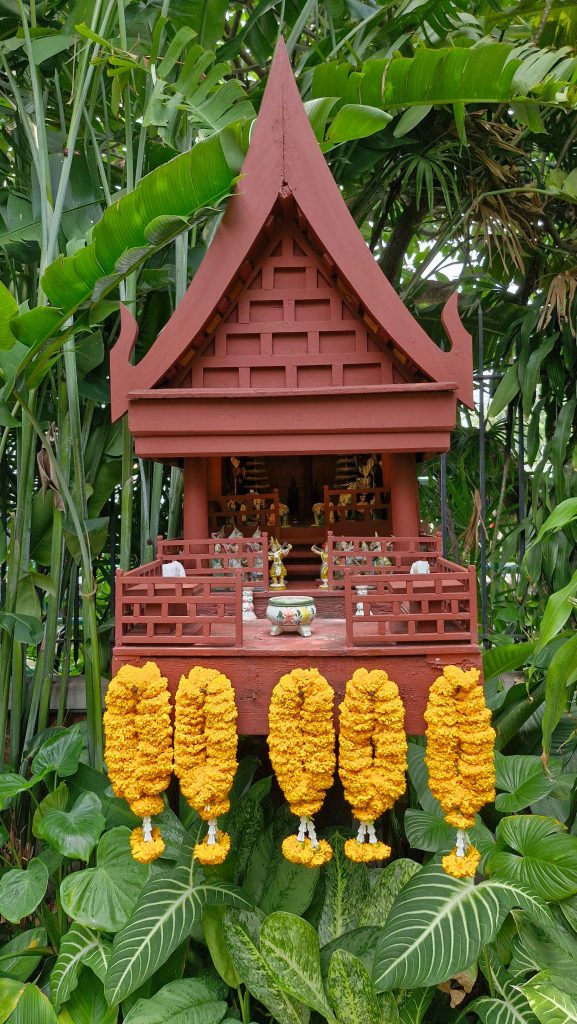
I didn’t ask anyone what they were. I just kept noticing them, the way you notice something everywhere once you’ve seen it once. It wasn’t until I got home to the Philippines and was going through my photos that I actually sat down and looked into it.
They’re called spirit houses. San phra phum, in Thai, ศาลพระภูมิ, which translates roughly to “shrine of the guardian spirit of the place.” And the more I read about them, the more I found myself thinking less about Thailand and more about home.
What a Spirit House Actually Is
The idea behind a spirit house is older than Buddhism in Thailand. It comes from animist belief: the notion that land already belongs to something before people ever build on it. When you construct a home or a hotel or a 7-Eleven on a piece of ground, you’re displacing whatever was there first, usually Phra Phum, the guardian spirit of the soil, sometimes other land or ancestral spirits called chao thi.
So you build them a house. A proper one, sized appropriately, placed with real thought. Where the spirit house goes isn’t casual. A monk, a Brahmin priest, or an astrologer is often consulted, and there are rules: it shouldn’t sit in the shadow of the main building, it shouldn’t face a toilet or a road, it should be visible and respectful, not tucked away like an afterthought. Sometimes a foundation hole gets dug before installation, and coins, amulets, or stones are placed inside as part of inviting the spirits in.
After that, it’s daily maintenance. Fresh jasmine or marigold garlands. Incense. Fruit, food, candles. And famously, bright red or orange Fanta, because the color is considered pleasing to the spirits. Some spirit houses have small figurines inside, attendants, dancers, elephants, an old man and woman meant to represent ancestral guardians.
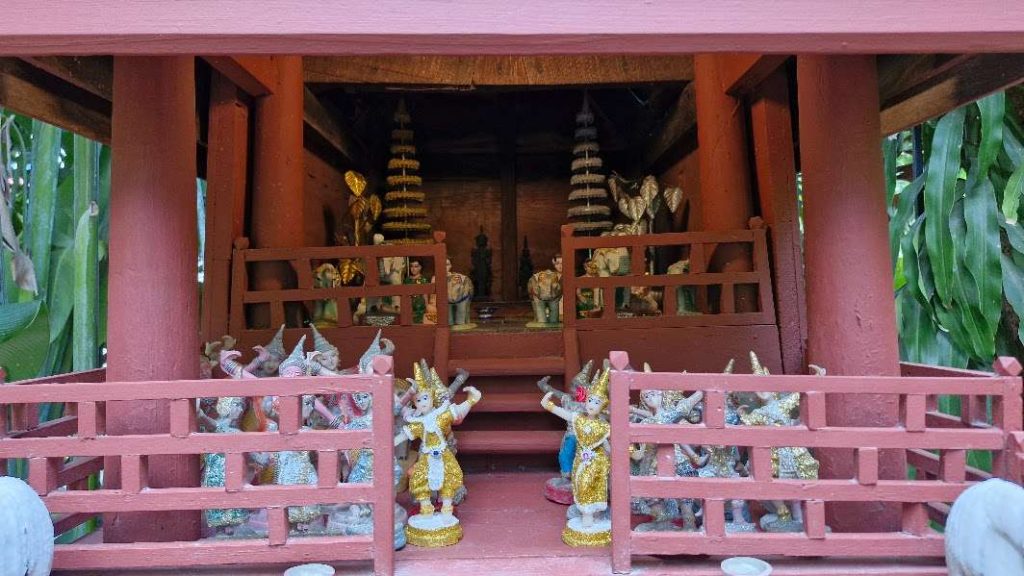
What struck me wasn’t the ritual itself so much as how unremarkable it seemed to everyone around me. Nobody was staring at these shrines or explaining them to a foreigner. They were just there, part of the architecture of daily life, tended to the way you’d water a plant or sweep a doorstep. Not a tourist attraction. Not a museum piece. A living practice, still being practiced, in one of Southeast Asia’s biggest, most modern cities.
Realizing We Have the Same Story
Reading about Phra Phum sent me looking into whether the Philippines had anything similar, and it turns out we do, or did.
We have duwende, nuno sa punso, engkanto, lamang-lupa, broader anito and nature spirits. The logic is nearly identical to the Thai belief: land is inhabited before you ever get to it. Anthills, old trees, certain patches of earth, these already belong to something. Build on top of that without acknowledgment, and you risk misfortune, illness, or worse.
We even have the phrase for it. “Tabi-tabi po,” excuse me, please, said when passing a mound or an old tree or anywhere a spirit might be dwelling. It’s a small verbal courtesy, an acknowledgment that you’re a guest on land that isn’t only yours.
There were construction rituals too. Padugo, a blood-letting ritual, usually a chicken, its blood sprinkled on the posts or foundation of a new structure. Wine or drinks poured into footings. Coins or rice placed under posts. Sometimes an albularyo, a folk healer, would be consulted to make sure the spirits were properly appeased before anyone moved in.
And we had actual spirit houses too, not just gestures. Small roofed platforms or altars, dambana, latangan, tangpap, and among the Itneg people, something much larger and more ceremonial called the balaua. These weren’t symbolic. They were structures built specifically to house anito, ancestral and nature spirits, the same basic gesture as a Thai san phra phum: here, this is yours, please don’t trouble us.
Reading all of this side by side felt strange in a specific way. Not the strangeness of discovering something foreign, but the strangeness of discovering something that used to be ours, described back to me through someone else’s living tradition.
Where One Tradition Stayed and the Other Faded
Here’s the part I keep sitting with. In Bangkok, this isn’t a relic. It’s active. Spirit houses stand outside 7-Elevens and five-star hotels and government buildings, tended daily by people who may or may not be devout Buddhists, because the tradition predates and sits alongside religion rather than depending on it. Old belief and modern city coexisting without apparent friction.
I can’t say the same for what I grew up around. I don’t see spirit houses in Philippine cities. I don’t hear “tabi-tabi po” said out loud very often anymore, not where I live, not among people my age. Duwende and nuno sa punso have mostly become things you mention as a joke, or a story you tell a kid to keep them from wandering into tall grass, rather than a belief that shapes where and how you build.
I don’t want to overstate this into something more dramatic than it is. Filipino culture didn’t vanish. Plenty of provincial and rural communities still hold onto these practices in ways I simply haven’t witnessed myself, and Catholic house blessings exist right alongside older, quieter customs in a lot of households, whether people think of it that way or not. This isn’t a eulogy for a dead culture. It’s closer to a small, specific sadness: the sense that a belief which once sat this close to ours, close enough that a stranger reading about Thailand could recognize their own grandmother’s warnings in it, has mostly gone quiet where I live, while the neighboring version of it never stopped being spoken.
I don’t have a tidy conclusion for that. I don’t think one is owed. I just know I flew to another country, saw a small house built for something unseen, and came home to find the closest version of it in my own culture living mostly in old ethnographic notes and a phrase people say without quite remembering why.
